
ADHD Online Webinar: Experts Speak about ADHD and Binge-eating Disorder

By Lisa Fields

white square image
Webinar episodes Awareness Month 2023 02B image

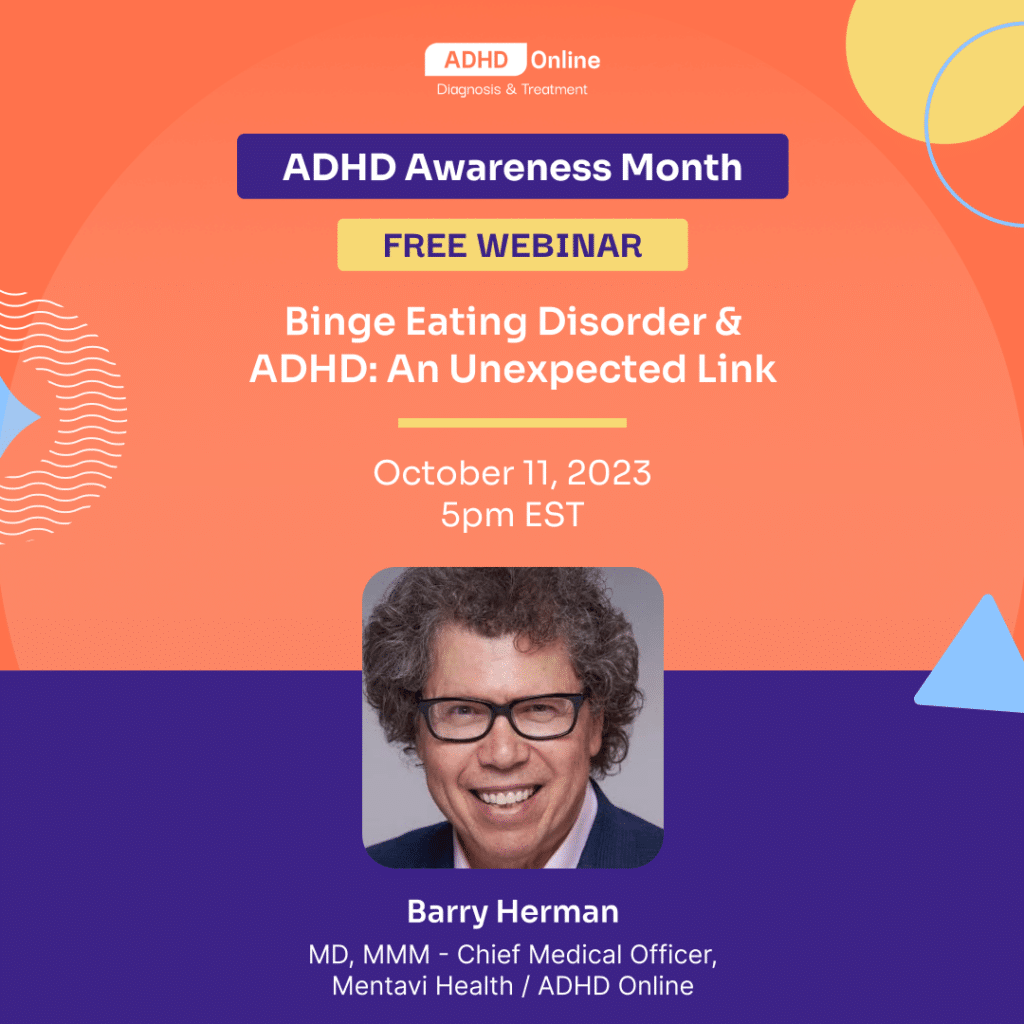
Because many people with ADHD are diagnosed with binge-eating disorder, ADHD Online hosted a webinar this month — as part of ADHD Awareness Month — to share information about both conditions.

ADHD Online’s Chief Medical Officer Barry K. Herman, M.D., a board-certified psychiatrist, spoke about binge-eating disorder and ADHD during the Oct. 11 webinar — the second in our series of October webinars about ADHD.

About 30% of patients with ADHD have some type of disordered eating, (and) the majority of patients who have eating problems with ADHD have binge-eating disorder,” Dr. Herman said during the webinar. “Somewhere between 20 and 25% of patients with ADHD have binge-eating disorder. And conversely, patients with binge-eating disorder have about a 20% chance that they also have co-occurring ADHD.”

People with binge-eating disorder consume large amounts of food in short periods of time. While binging, they often eat quickly, continuing when they’re full. They may binge when they’re alone.

“They hide their binge behaviors,” Dr. Herman said. “They’re often very embarrassed and ashamed and distressed about it.”

Many people with binge-eating disorder think that they have a willpower problem, not an eating disorder. The condition wasn’t formally recognized until 2013, when it was added to the Diagnostic and Statistical Manual of Mental Disorders, Fifth Edition (DSM-5), which providers use to diagnose mental health conditions.

Binge-eating disorder shares similarities with bulimia nervosa, another eating disorder. People with bulimia binge, but they also purge — to somehow get rid of what they’ve eaten afterwards. People with binge-eating disorder generally do not do that.

“Patients (with bulimia) engage in … compensatory behaviors to undo the effect of the binge,” such as vomiting, taking laxatives or exercising excessively to burn calories, Dr. Herman said. “With binge-eating disorder, there are no compensatory behaviors.”

Binge-eating disorder also shares similarities with ADHD.

“Both disorders are characterized by what we call dopamine signaling dysregulation,” Dr. Herman said. “The circuits that are regulated by dopamine (a ‘feel-good’ neurotransmitter) are not functioning properly.”

ADHD arises earlier in life than binge-eating disorder.

“ADHD starts in childhood,” Dr. Herman said. “Binge-eating disorder actually starts usually later on, meaning either very late adolescence or early adulthood.”

Providers can assess patients for ADHD and binge-eating disorder simultaneously.

Treatments for binge-eating disorder include psychotherapy and medication. Vyvanse (lisdexamfetamine) has been approved to treat binge-eating disorder. It’s also approved to treat ADHD.

During the webinar, Dr. Herman also talked about screening questions that help to diagnose binge-eating disorder, possible reasons why some people with binge-eating disorder eat excessively at night, possible reasons why many people with binge-eating disorder are not obese and whether or not treatments for binge-eating disorder help patients lose weight.

The third and fourth webinars in ADHD Online’s series will take place Oct. 24 and 25. The Oct. 24 webinar, beginning at 5 p.m. E.T., will include experts exploring and explaining non-stimulant treatment options for ADHD. Dr. Herman and Lakeisha Love, a nurse pracitioner who is dual-certified in family medicine and family psychiatry, will be the presenters.

The Oct. 25 webinar, beginning at 3 p.m. E.T., will explore the connections between ADHD, depression and anxiety. Two presenters will share information about these three conditions, then answer viewers’ questions on these topics. Presenters will be David Toomey, D.O., a family physician with experience in psychological childhood trauma counseling, and Nicole Falcon, a certified family nurse practitioner who specializes in child, adolescent and adult psychiatry.


The Expert Mental Health Care You Need Now

From ADHD to anxiety and beyond—we can help.
Start Your Assessment

Learn About ADHD Services in Your State

Live your best life with ADHD

Learn more about the three steps to Medical Treatment for ADHD
3 Simple Steps

More than ADHD?

From anxiety and depression to binge eating and obsessive compulsive disorder, ADHD rarely operates alone. Our Mentavi Diagnostic Evaluation screens for common comorbidities.
Learn More
Explore More

How Women Can Take Care of Their Mental Health

Approximately one in five women in the United States and the United Kingdom experience common mental health challenges

The True Value of an Official ADHD Diagnosis

Value is one of those words with multiple meanings. Why an accurate ADHD diagnosis is invaluable...

ADHD in Men vs Women: Understanding the Differences

Sharing your ADHD diagnosis can lead to better support and understanding. If you're thinking about taking that step,
Articles

The constant present: Time blindness and ADHD

“Where did the time go?” It’s a question that everyone asks from...
Podcasts

Part Two: ADHD and Time Blindness with Dr. Ari Tuckman

Today, we’re continuing our conversation with Dr. Ari Tuckman, exploring...
Webinars

Mentavi Holiday Wellness Series 2025

This season doesn’t have to feel overwhelming. Join our FREE...

Curious about stimulant or non-stimulant approaches?

These terms refer to certain approaches to treat diagnosed ADHD. Mentavi Health / ADHD Online may provide stimulant approaches (certain medications under medical treatment that are generally considered Class II controlled substances) or non-stimulant approaches (medications generally not considered Class II, and/or therapy and coaching not related to medication).

A diagnosis and initial conversation with our treatment clinicians is key to the best path for you. The diagnosis is a key first step to determine if you have ADHD or other related conditions. Approximately 60% of patients with ADHD have co-occurring conditions such as anxiety or depression, for example. At the same time, patients who believe they have ADHD may not even have it. For those who do, there can be a variety of considerations into what kind of treatment works best to meet the patient where they’re at.

If you are not feeling right, your journey starts with the first step of diagnostic evaluation.

There may be a brief delay in service today between 12:30 PM and 1:30 PM ET. Thank you for your patience — we look forward to assisting you shortly.
 
The ADHD Online Team

Join Our ADHD Research Study

Mentavi Health is conducting ADHD research and is accepting a limited number of participants. Participants in our clinical study will get an ADHD Assessment at no cost. 

Who can join?
  • Age 19+
  • Primary language is English
  • Not previously diagnosed with ADHD
  • Not a current patient of ADHD Online or Mentavi Health
  • A resident of any of the 50 US states or DC (not including Puerto Rico or other territories)
 
Why participate?
Your involvement will help improve mental health care for everyone.
 
Looking to take our assessment? That’s available all day, every day, whenever and wherever is best for you!

ADHD Online will be closed on Monday, May 26, 2025, in observance of the Memorial Day holiday.

Live support will be unavailable on Monday, May 26. Send us an email or leave a message, and we’ll get back to you as soon as possible when we return on Tuesday, May 27.

Please note that each clinician sets their holiday hours and may be processing your requests during this time or may also be out.

Live support will be unavailable during regular business hours on Monday, January 20. You can always submit a request or leave a voice message. We’ll get back to you when we return.

Please note: Our clinicians have individual holiday schedules. Check with yours for their availability during the holidays.

Looking to take our Mentavi Diagnostic Evaluation? That’s available all day, every day, whenever and wherever is best for you!

Our site is open 24/7! You can always schedule an appointment, check out our podcasts, or read up on the latest ADHD information.

ADHD Online will be closed on Thursday, November 27 and Friday, November 28 in observance of Thanksgiving.

Live support will be unavailable during this time, but you can always submit a request or leave a voice message. We’ll get back to you when we return on Monday, December 1.

Each of our clinicians sets their own holiday hours. Check with your doctor for availability.

Are you looking to take our Assessment? It’s available all day, every day, whenever and wherever is best for you! 

Provide this form to your local practitioner. You could:

  • Send this link
  • Email the pdf
  • Print it out and bring it to your appointment

Ask your practitioner
to complete the form

In this form, your practitioner will request that ADHD Online continue to provide uninterrupted care

Return the form to us

You or your practitioner can return this form to us via email or fax it to 616-210-3118